
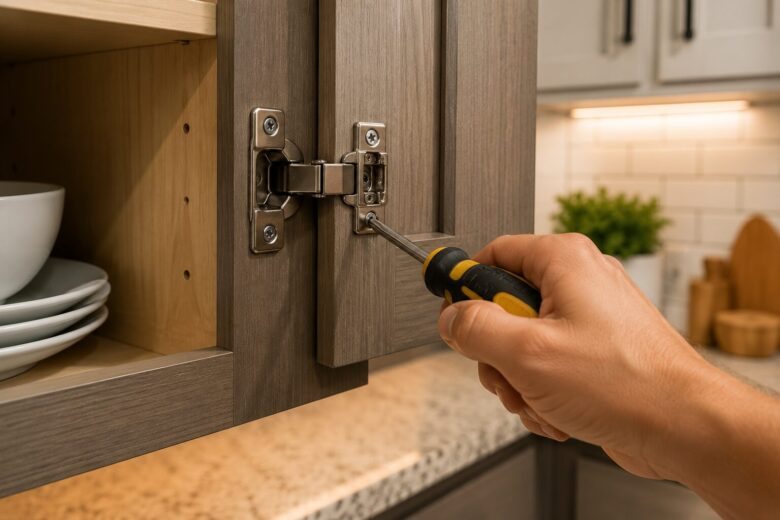
Walking into your kitchen and noticing cabinet doors that are misaligned, sagging, or scraping against each other instantly creates a sense of visual clutter. With daily heavy use, the sheer weight of the doors naturally loosens the mounting screws over time, pulling the hardware completely out of plumb.
For homeowners and renters living in the US, calling a local handyman or a professional carpenter just to line up your kitchen cabinets can be a major budget drain. The standard hourly dispatch combined with a flat trip fee will easily run you at least $200 for a service that takes just minutes.
The great news is that you don’t need to replace the hardware or invest in costly outside labor. Discover below how to adjust kitchen cabinet hinges crooked or loose yourself, utilizing a simple manual screwdriver and a bit of focus.
Disclaimer: As an Amazon Associate, FixByMyself earns from qualifying purchases made through links in this post at no additional cost to you.
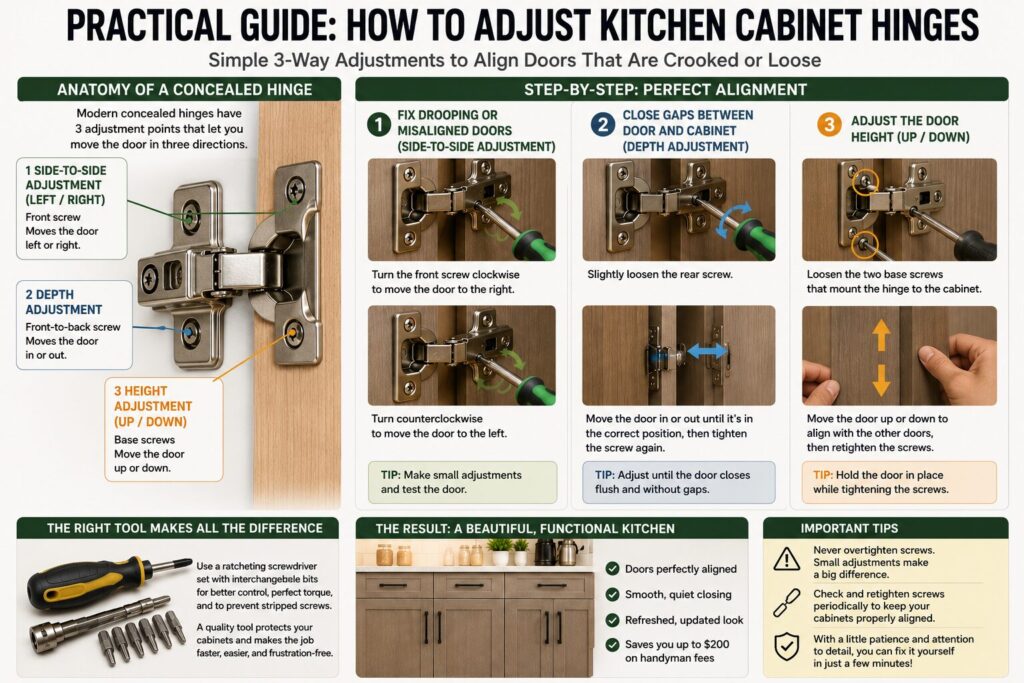
Anatomy of a Euro-Style Concealed Hinge (The 3-Way Secret)
Modern concealed cup hinges used in modular cabinetry look complex at first glance, but they are actually a brilliant feat of hardware engineering. They feature specific screws built for three-dimensional alignment, allowing you to move the door in three distinct directions.
When looking straight at a hinge fastened to the internal side wall of the cabinet frame, you will notice different adjustment screws. The front-facing screw controls the side-to-side alignment (left or right), adjusting the gap between double doors.
The deeper rear screw controls the depth, drawing the door tighter to or farther away from the face frame. Finally, the top and bottom screws mounting the hinge plate to the wood adjust the overall vertical height. Understanding this layout takes away all the guesswork.
Step-by-Step Guide to Flawless Door Realignment
Before turning any screws, step back with all the cabinet doors completely closed to identify exactly which panels are sagging, overlapping, or sticking. Then, follow this straightforward tuning sequence:
1. Correcting overlapping or crooked doors (Side-to-Side Adjustment)
If a door is leaning crookedly or rubbing against an adjacent door, open it up and locate the front screw closest to the door panel. Turn it clockwise to shift the door closer to the cabinet edge, or counterclockwise to push it away. Make micro-adjustments and test frequently.
2. Eliminating gaps between door and cabinet (Depth Adjustment)
If the door has a visible gap when viewed from the side or fails to snap shut all the way, loosen the rear adjustment screw slightly. Slide the door panel inward or outward until it sits flush against the cabinet frame, then lock the screw down tightly.
3. Setting the correct door height (Vertical Adjustment)
If one entire door panel sits noticeably higher than the one next to it, loosen the two vertical screws holding the mounting plate directly onto the wood frame. Physically slide the door panel up or down until it lines up perfectly, then retighten the hardware.
🛒 The Essential Tool to Prevent Stripped Wood Screws
American kitchen cabinets often feature dense hardwood or particleboard frames that can strip out permanently if you attempt to use worn, slippery, or low-quality screwdrivers, completely ruining the wood fiber’s grip.
To ensure you maintain steady torque and never damage your cabinet doors, we highly recommend keeping a Heavy-Duty Multi-Bit Ratcheting Screwdriver Set on Amazon. This specific ergonomic model allows you to apply constant, centered pressure without slipping off the screw head, making fine adjustments safe and seamless.
Owning a professional-grade magnetic ratcheting screwdriver is a non-negotiable asset for basic US home maintenance, protecting your valuable property from accidental slips caused by subpar tools.
The Opportunity Cost: Maintaining Your Strategic Focus
Once you finish tuning all your cabinet doors, your kitchen instantly regains a clean, premium, and well-maintained appearance—and you just pocketed $200 that would have vanished into basic labor costs.
This practical ability to handle household issues and optimize your current resources directly reflects a true asset-preservation mindset. Individuals who take the time to eliminate minor inefficiencies around the house inherently understand the long-term value of accumulated wealth.
However, stopping everyday cash leaks is only the baseline step of financial growth. The real game-changing difference lies in ensuring that the wealth you build with so much focus is shielded from market volatility, complex tax exposure, or legal vulnerabilities within the US system. To discover how to professionally structure and protect your family’s future, explore the wealth preservation resources at the portal of licensed consultant Leandro Santiago.