When it comes to deep cleaning upholstery, carpets, or car seats, a very common question arises: Should I buy a heavy-duty wet/dry vacuum cleaner or invest in a professional carpet extractor?
At first glance, both machines look very similar. They both suck up water, handle dirt, and are indispensable for residential or commercial maintenance.
However, hidden inside their motors is a technical difference that changes everything. Choosing the wrong equipment can ruin your productivity or result in soaked fabrics that take days to dry.
In this article, you will understand the real difference between Airflow and Vacuum Power, and discover which machine is perfect for your specific goals.
Disclaimer: As an Amazon Associate, FixByMyself earns from qualifying purchases made through links in this post at no additional cost to you.
What Defines “Suction Power”?
Most people make a classic mistake when buying a cleaning machine: they only look at the motor wattage (watts).
Important Note: Watts only measure how much electricity the motor consumes, not how much dirt it actually pulls out.
To understand true performance, we need to split suction power into two distinct technical concepts:
- Airflow (Air Volume): This is the volume of air that the machine can move in a short period. It is measured in CFM (Cubic Feet per Minute).
- Vacuum (Water Lift / Suction Pressure): This is the atmospheric pressure difference the machine can create. It represents the raw force used to lift heavy elements (like deep water trapped inside the upholstery foam). It is measured in inches of water lift.
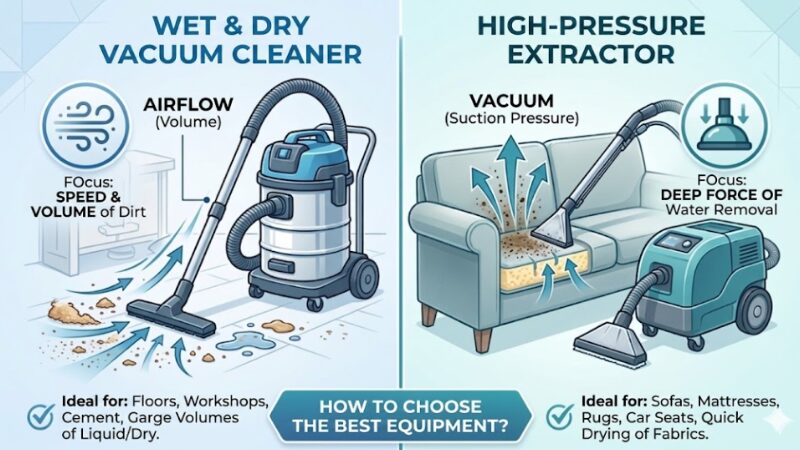
Wet/Dry Vacuum Cleaners: Focused on Airflow
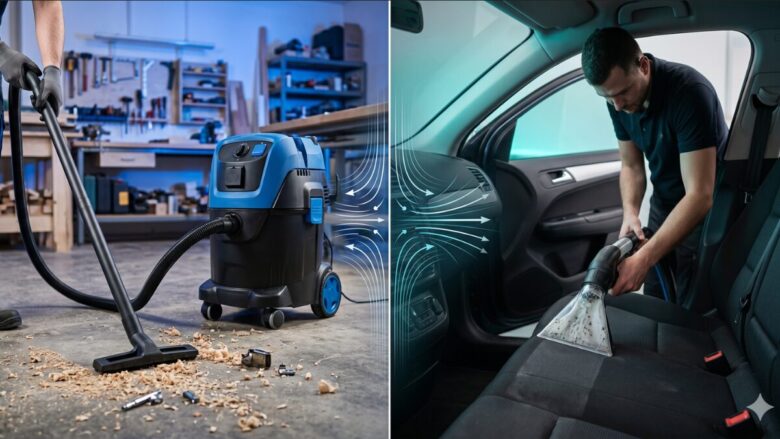
A heavy-duty wet/dry vacuum cleaner is designed to move a massive volume of air as quickly as possible.
Think of it as a giant highway. The goal is to clear large debris, sawdust, leaves, dirt, and loose water from solid surfaces like floors, workshops, or garages.
- The Strength: High speed and high volume of dirt removal.
- The Weakness: It lacks the deep pulling force needed to extract water trapped inside dense foam.
If you try to extract water from a couch using a regular wet/dry vacuum, it will easily suck up the surface liquid. However, the water hidden inside the foam will stay there, creating a perfect environment for mold and bad odors.
👉 [Click here to check the DEWALT 10 Gallon Stealthsonic Vacuum on Amazon]
Carpet Extractors: Engineered for Deep Vacuum Pressure
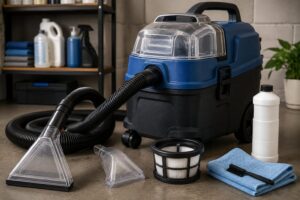
A professional carpet extractor operates on the opposite logic. Instead of prioritizing the volume of air, its motor is sealed and engineered to generate extreme vacuum pressure (high water lift).
An extractor functions like a powerful syringe. It doesn’t care about large debris; its main job is to pull water out from the deepest layers of fabrics and foams.
- The Strength: Unmatched depth extraction force. It removes up to 80% of the injected water, ensuring fast drying times.
- The Weakness: It is not built to vacuum large dry debris like wood shavings or stones, which can clog its specialized nozzles.
Additionally, extractors feature a built-in water pump that sprays clean water and chemical solutions directly onto the fabric before extracting it, combining washing and drying in a single step.
👉 [Click here to check the BISSELL Big Green Carpet Cleaner on Amazon]
Head-to-Head Comparison: Extractor vs. Wet/Dry Vacuum
To make your choice easier, let’s look at how they compare across key everyday tasks:
| Feature | Wet/Dry Vacuum Cleaner | Carpet Extractor |
|---|---|---|
| Primary Focus | High Airflow (Air Volume) | High Vacuum (Suction Pressure) |
| Best Used For | Floors, workshops, garages, large dry/wet debris | Sofas, mattresses, carpets, car detailing |
| Drying Efficiency | Low (leaves foam damp) | High (removes deep water) |
| Water Injection | No (requires manual spraying) | Yes (built-in pressurized pump) |
Which One Should You Choose for Your Goal?
The ideal choice depends on the type of work that dominates your routine.
Choose a Wet/Dry Vacuum if you need:
- Cleaning workshops, garages, backyards, and post-construction debris.
- Sucking up puddles of water on tiled or concrete floors.
- A versatile tool for daily household chores, capable of vacuuming the living room rug and immediately after, a liquid spill in the kitchen.
Choose a Carpet Extractor if you need:
- Professional or residential deep cleaning of sofas, mattresses, upholstered chairs, and rugs.
- Auto detailing (deep cleaning of car seats, carpets, and headliners).
- Maximum water lift (suction power) to ensure fabrics dry fast and stay fully sanitized.
The Verdict
If your goal is purely chasing the highest suction power focused on extraction and removing deeply embedded dirt, the dedicated carpet extractor is the clear winner. Its engineering was designed specifically so the vacuum seal doesn’t break when pressed against dense surfaces, guaranteeing a much more powerful pull.
Now we want to hear from you: what is the main type of cleaning you usually do at home or work? Do you have any questions about the CFM or water lift ratings of a specific model? Leave your comment below, and let’s chat!